- Home
- Tutorial
- Resource Guides
- Focus Areas
- LSF Programs
-
Professional
Development - Review Process
-
A project of LSF

Search for Resources
Ozone Day
Ozone Day
September 16th, 2026
Top R4R Picks
Resources for extending the learning
-
Healthy Air Versus Polluted Air QualityMiddle, Secondary
-
Reset EarthElementary, Middle, Secondary
-
What is Climate Change-Climate KidsElementary, Middle
-
The Clean Air GameElementary, Middle
-
Introduction to Air QualityElementary
-
Pollutants in Your EnvironmentSecondary
-
Our Changing Climate for Grades 3 to 6Elementary, Middle
-
Our Changing Climate for Grades 6 to 12Middle, Secondary
-
OzonAction Education Pack for Secondary Schools: Sessions 1-4Elementary, Secondary
-
OzonAction Education PackElementary
-
Why Is Coco Orange?Elementary
-
Air Pollution 101Elementary, Middle, Secondary
-
-
Ozzy Ozone (En)Elementary
The United Nations International Day for the Preservation of the Ozone Layer is celebrated each year around the world on September 16, a date that marks the 1987 signing of the Montreal Protocol. This international treaty was enacted to protect the ozone layer by eliminating the use of ozone-depleting substances and has led to the phase-out of 99 per cent of ozone-depleting chemicals in refrigerators, air-conditioners and many other products. These efforts have provided protection for the ozone layer and in doing so, helped to improve human and ecosystem health by limiting incoming harmful UV radiation.
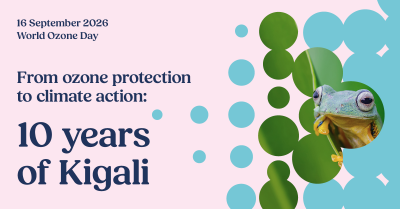
In 2026, an amendment to the Montreal Protocol was agreed to and signed in Kigali, Rwanda to launch a gobal effort aimed at phasing out the production and use of hydrofluorocarbons (HFCs). While these gases that are also widely used in refrigeration and air conditioning do not harm the ozone layer, they are extremely potent greenhouse gases. It is anticipated that this programme will reduce HFC use by 80 to 85 percent by 2046.

One of the primary objectives of World Ozone Day is to educate people about the crucial role the ozone layer plays in preserving life on Earth and this year’s theme,‘2026: Global Action for a cooler planet’ will also celebrate 10 years of sustainable cooling achieved under the Kigali Amendment.
In the days leading up to September 16, primary and secondary school educators throughout the world are encouraged to organize classroom activities that focus on topics related to ozone, the ozone layer, greenhouse gases and the importance of global action on behalf of the environment.
Why Care About The Ozone Layer?
- The ozone layer acts as an atmospheric shield. All life on earth depends on its protection from the lethal levels of ultraviolet radiation produced by the sun.
- Negative changes in the ozone layer are being offset by positive changes in human behavior, allowing the ozone layer to reform. The role the ozone hole itself plays in global warming and the resulting climate change is small compared to the impacts coming from human activities. (NASA)
- Cause and effect has been established between a thinning of the ozone layer and increased incidence of skin cancer.
- Declines in crop yields of up to 50% in some countries have been linked to increased amounts of incoming UV radiation. A thinner ozone layer is also a factor in the declining concentrations of phytoplankton that support aquatic food webs.
- Many ozone depleting substances remain active in the atmosphere for 50 to 100 years and most ozone depleting substances are also greenhouse gases.
- Ozone protection efforts to date are making a difference. Parts of the ozone layer have recovered at a rate of 1-3% per decade since 2000. At projected rates, Northern Hemisphere and mid-latitude ozone will heal completely by the 2030s. Complete global healing is expected by 2060.
- Actions taken under the Montreal Protocol have safeguarded carbon reserves to the tune of 690 billion metric tons. (estimate as of Aug 2021)
- The Kigali amendment has been called a cooling powerhouse. It’s impact on HFC reduction is expected to prevent up to .5oC of global warming by 2100. (UNEP 2026)
- The effort to preserve the ozone layer shows how collective action guided by science can solve major global crises.
Resources 4 Rethinking supports student and teacher participation in Ozone Day Activities. Top R4R Picks will connect you to some excellent classroom resources.
For more information and activities be sure to check out the International Day for the Preservation of the Ozone Layer website.