- Home
- Tutorial
- Resource Guides
- Focus Areas
- LSF Programs
-
Professional
Development - Review Process
-
A project of LSF

Search for Resources
Description
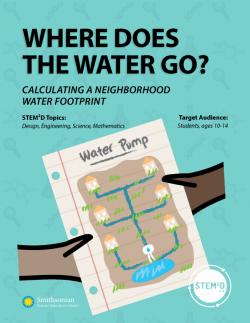
Where Does the Water Go? is a hands-on water conservation learning activity in which students will calculate the water use of different households in a fictional town, determine if there is sufficient water for the town’s needs and design a water pump to move the water from the reservoir to the houses.
The activity begins with the students, in groups of 4, estimating their personal water usage and calculating a class average for water use in a variety of categories. They then compare their estimates with statistics from the government's database. Each group will then be assigned a household from the fictional town of Sunnybrook Circle. They will create a water usage footprint for their assigned household
Next the students will be challenged with an engineering design exercise of building a water pump to move water from the reservoir to the houses in Sunnybrook. They are provided a bag of materials to build their pump. Once the pumps are working, the students must go to the “Water District” (teacher) to get their needed amount of water. The available amount of water is 2 250 gallons which is represented by cups of colored discs. As water is allocated to each group, students will discover that the needs of the town may exceed to amount of available water.
The students will complete a handout as a final reflection activity.
Note: The lesson links users to the U.S. Department of the Interior water-use estimates and uses gallons rather than litres as the unit of measurement for water consumption. Teachers may wish to use water-use data available from Statistics Canada and other local sources that reflect their own communities.
General Assessment
Recommendation of how and where to use it
This resource is best suited for the middle school Science classroom. It is a well designed STEM activity that addresses curriculum outcomes related to water, water use, sustainability and ecological footprints.
Relevant Curriculum Units
The following tool will allow you to explore the relevant curriculum matches for this resource. To start, select a province listed below.
- Step 1Select a province
- Alberta
- Manitoba
- New Brunswick
- Newfoundland & Labrador
- Nova Scotia
- Nunavut
- Ontario
- Step 2Select a grade level
- Grade 5
- Step 3Select a subject
- Science & Technology
- Step 4Relevant matches
- STEM Skills and Connections
- Grade 6
- Step 3Select a subject
- Science & Technology
- Step 4Relevant matches
- STEM Skills and Connections
- Grade 7
- Step 3Select a subject
- Geography
- Step 4Relevant matches
- Natural Resources around the World: Use and Sustainability
- Science & Technology
- Step 4Relevant matches
- STEM Skills and Connections
- Grade 8
- Step 3Select a subject
- Science & Technology
- Step 4Relevant matches
- Earth and Space Systems: Water Systems
- STEM Skills and Connections
- Prince Edward Island
- Quebec
- Step 2Select a grade level
- Grade 6
- Step 3Select a subject
- Science & Technology
- Step 4Relevant matches
- Living Things
- Grade 7
- Step 3Select a subject
- Science & Technology
- Step 4Relevant matches
- The Technological World
- Grade 8
- Step 3Select a subject
- Science & Technology
- Step 4Relevant matches
- The Technological World
- Saskatchewan
Themes Addressed
Citizenship (2)
- Ecological Footprint
- Sustainable Consumption
Water (3)
- Water Quality
- Water Treatment and Distribution
- Water Use