- Home
- Tutorial
- Resource Guides
- Focus Areas
- LSF Programs
-
Professional
Development - Review Process
-
A project of LSF

Search for Resources
Description
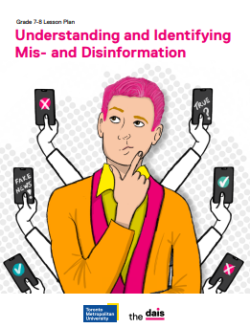
These lessons will help students understand the importance of accurate information; the distinctions between misinformation, disinformation, and biased information; and common techniques used to deliberately spread false and misleading content. These skills and knowledge will make them more critical consumers of media and more responsible participants in public conversations—both online and offline.
The lesson covers four key ideas
- Why is it important to be well informed
- What are misinformation, disinformation and biased information?
- What are strategies used to deliberately spread false and misleading content?
- How can I avoid being mislead?
This set of lessons begins with substantial guidance and support for students and gradually moves towards greater student independence. Activities include:
The Council of Advisors Game, a structured activity where students evaluate the accuracy of different claims using pre-selected fact-checking sources. Students have a specific question to research and pre-selected sources to consult (in the fact-checking boxes). The discussion to follow this activity is directed by the teacher.
The Classification Game requires students to research an assigned statement and evaluate sources to determine whether it is true or false. Students justify their answers.
The Bad News Game can be played as a class, or in small groups, allowing for different levels of independence. It introduces students to common tactics used to spread disinformation and mislead people. A graphic organizer helps students record their learning and understand key concepts and vocabulary.
The Public Service Announcement activity is entirely self-directed, students create a poster, social media post, or short video highlighting characteristics of misleading content and warning people to think before they share content with these characteristics. Students select both the topic and form, video, poster, social media post, etc. of their PSA.
General Assessment
What skills does this resource explicitly teach?
- These lessons will help students understand the
importance of accurate information; the distinctions between misinformation, disinformation, and biased information; and common techniques used to deliberately spread false and misleading content. - These skills and knowledge will make them more critical consumers of media and more responsible participants in public conversations—both online and offline
Strengths
-
The lesson explores a current issue that is particularly relevant to students’ lives
-
Lesson is age appropriate and easy to use
- Excellent background information and assessment strategies for teachers
-
Students learn how messages are designed to influence audiences, which supports digital and media literacy.
-
Creating a public service announcement (PSA) encourages creativity and active participation.
Recommendation of how and where to use it
This lesson is designed for students in grades seven and eight and focuses on helping students develop digital media literacy and fact-checking skills.
Relevant Curriculum Units
The following tool will allow you to explore the relevant curriculum matches for this resource. To start, select a province listed below.
- Step 1Select a province
- British Columbia
- Step 2Select a grade level
- Grade 6
- Step 3Select a subject
- English/Language Arts
- Step 4Relevant matches
- Questioning what we hear, read, and view contributes to our ability to be educated and engaged citizens
- Grade 7
- Step 3Select a subject
- English/Language Arts
- Step 4Relevant matches
- Questioning what we hear, read, and view contributes to our ability to be educated and engaged citizens
- Grade 8
- Step 3Select a subject
- English/Language Arts
- Step 4Relevant matches
- Questioning what we hear, read, and view contributes to our ability to be educated and engaged citizens.
- Manitoba
- Step 2Select a grade level
- Grade 6
- Step 3Select a subject
- English/Language Arts
- Step 4Relevant matches
- Language as Power and Agency
- Grade 7
- Step 3Select a subject
- English/Language Arts
- Step 4Relevant matches
- Language as Power and Agency
- Grade 8
- Step 3Select a subject
- English/Language Arts
- Step 4Relevant matches
- Language as Power and Agency
- New Brunswick
- Step 2Select a grade level
- Grade 8
- Step 3Select a subject
- English/Language Arts
- Step 4Relevant matches
- Reading
- Newfoundland & Labrador
- Step 2Select a grade level
- Grade 6
- Step 3Select a subject
- English/Language Arts
- Step 4Relevant matches
- Reading & Viewing
- Grade 8
- Step 3Select a subject
- English/Language Arts
- Step 4Relevant matches
- Reading and Viewing
- Northwest Territories
- Step 2Select a grade level
- Grade 7
- Step 3Select a subject
- English/Language Arts
- Step 4Relevant matches
- Questioning what we hear, read, and view contributes to our ability to be educated and engaged citizens
- Grade 8
- Step 3Select a subject
- English/Language Arts
- Step 4Relevant matches
- Questioning what we hear, read, and view contributes to our ability to be educated and engaged citizens.
- Nova Scotia
- Step 2Select a grade level
- Grade 6
- Step 3Select a subject
- English/Language Arts
- Step 4Relevant matches
- Reading and Viewing
- Information Technology
- Step 4Relevant matches
- Information and Communication Technology 6: Digital Citizenship
- Grade 7
- Step 3Select a subject
- English/Language Arts
- Step 4Relevant matches
- English Language Arts 7
- Grade 8
- Step 3Select a subject
- English/Language Arts
- Step 4Relevant matches
- English Language Arts 8
- Nunavut
- Step 2Select a grade level
- Grade 7
- Step 3Select a subject
- English/Language Arts
- Step 4Relevant matches
- Comprehend and Respond
- Grade 8
- Step 3Select a subject
- English/Language Arts
- Step 4Relevant matches
- Comprehend and Respond
- Ontario
- Step 2Select a grade level
- Grade 6
- Step 3Select a subject
- English/Language Arts
- Step 4Relevant matches
- Language: Composition: Expressing Ideas and Creating Texts
- Language: Comprehension: Understanding and Responding to Texts
- Language: Literacy Connections and Applications
- Grade 7
- Step 3Select a subject
- English/Language Arts
- Step 4Relevant matches
- Language: Literacy Connections and Applications
- Grade 8
- Step 3Select a subject
- English/Language Arts
- Step 4Relevant matches
- Language: Literacy Connections and applications
- Prince Edward Island
- Step 2Select a grade level
- Grade 6
- Step 3Select a subject
- English/Language Arts
- Step 4Relevant matches
- Reading and Viewing
- Grade 7
- Step 3Select a subject
- English/Language Arts
- Step 4Relevant matches
- Reading and Viewing
- Quebec
- Step 2Select a grade level
- Grade 6
- Step 3Select a subject
- English/Language Arts
- Step 4Relevant matches
- To represent her/his literacy in different media
- Grade 7
- Step 3Select a subject
- English/Language Arts
- Step 4Relevant matches
- Represents her/his literacy in different media
- Grade 8
- Step 3Select a subject
- English/Language Arts
- Step 4Relevant matches
- Represents her/his literacy in different media
- Saskatchewan
- Step 2Select a grade level
- Grade 8
- Step 3Select a subject
- English/Language Arts
- Step 4Relevant matches
- Comprehend and Respond
- Yukon Territory
- Step 2Select a grade level
- Grade 6
- Step 3Select a subject
- English/Language Arts
- Step 4Relevant matches
- Questioning what we hear, read, and view contributes to our ability to be educated and engaged citizens
- Grade 7
- Step 3Select a subject
- English/Language Arts
- Step 4Relevant matches
- Questioning what we hear, read, and view contributes to our ability to be educated and engaged citizens
- Grade 8
- Step 3Select a subject
- English/Language Arts
- Step 4Relevant matches
- Questioning what we hear, read, and view contributes to our ability to be educated and engaged citizens.
Themes Addressed
Citizenship (1)
- Media
Economics (1)
- Corporate Social Responsibility
Sustainability Education Principles
| Principle | Rating | Explanation |
|---|---|---|
| Consideration of Alternative Perspectives | Very Good | These lessons and activities help students understand the importance of accurate information, the difference between misinformation, disinformation, and bias, and common techniques used to spread misleading content. |
Consideration of Alternative Perspectives:
| ||
| Multiple Dimensions of Problems & Solutions | Poor/Not considered | The lesson focuses on literacy and critical thinking skills related to misinformation and disinformation, such as defining key vocabulary and identifying techniques used to spread false information. It briefly touches on social impacts, like how misinformation influences public conversations, but it doesn't effectively explore the environmental, economic and social dimensions of the issue. |
| Multiple Dimensions of Problems & Solutions: Effectively addresses the environmental, economic and social dimensions of the issue(s) being explored.
| ||
| Respects Complexity | Very Good | The lessons help students understand the |
| Respects Complexity: The complexity of the problems/issues being discussed is respected. | ||
| Acting on Learning | Good | Students create a poster, social media post, or short video highlighting characteristics of |
| Acting on Learning: Learning moves from understanding issues to working towards positive change — in personal lifestyle, in school, in the community, or for the planet
| ||
| Values Education | Very Good | Students are given the opportunities to discuss the content and demonstrate their understanding of the issues. |
| Values Education: Students are explicitly provided with opportunities to identify, clarify and express their own beliefs/values. | ||
| Empathy & Respect for Humans | Poor/Not considered | Not considered in this resource. |
| Empathy & Respect for Humans: Empathy and respect are fostered for diverse groups of humans (including different genders, ethnic groups, sexual preferences, etc.). | ||
| Personal Affinity with Earth | Poor/Not considered | Not considered in this lesson plan. |
| Personal Affinity with Earth: Encourages a personal affinity with -the natural world.
| ||
| Locally-Focused Learning | Very Good | Students develop the skills to critically, effectively, and responsibly access, understand, and engage with information in the news and on social media. |
| Locally-Focused Learning: Includes learning experiences that take advantage of issues/elements within the local community.
| ||
| Past, Present & Future | Good | The background information for teachers explains how false content has evolved and why it is an increasingly significant problem. |
| Past, Present & Future: Promotes an understanding of the past, a sense of the present, and a positive vision for the future. | ||
Pedagogical Approaches
| Principle | Rating | Explanation |
|---|---|---|
| Open-Ended Instruction | Very Good | The lessons are very open-ended, students develop and apply criteria for evaluating ideas, information, and their sources. |
| Open-Ended Instruction
: Lessons are structured so that multiple/complex answers are possible; students are not steered toward one 'right' answer. | ||
| Integrated Learning | Good |
|
| Integrated Learning: Learning brings together content and skills from more than one subject area
| ||
| Inquiry Learning | Good | The instruction across both lessons is organized |
| Inquiry Learning: Learning is directed by questions, problems, or challenges that students work to address.
| ||
| Differentiated Instruction | Very Good | The resource includes a Guidance on Inclusion section that outlines differentiated instruction strategies for each activity in the lesson plan. It also suggests accommodations, supports and modifications for students with an IEP. |
| Differentiated Instruction: Activities address a range of student learning styles, abilities and readiness.
| ||
| Experiential Learning | Good | The purpose of the PSA activity is to have students reflect on what responsible online behavior looks like, specifically with reference to the spread of misand disinformation. By creating PSAs about how to spot disinformation and prevent its spread, they will have the opportunity to think about and effectively communicate |
| Experiential Learning: Authentic learning experiences are provided
| ||
| Cooperative Learning | Satisfactory | Classroom set-up for Lesson 1 is conducive to working in groups of 5-6 and enable mobility. Classroom set-up for lesson 2 is conducive for students pairing up in various combinations. |
| Cooperative Learning: Group and cooperative learning strategies are a priority.
| ||
| Assessment & Evaluation | Very Good | The resource includes Assessment for Learning suggestions for each activity. It incorporates both oral and written assessment methods and provides detailed rubrics to support evaluation. |
| Assessment & Evaluation: Tools are provided that help students and teachers to capture formative and summative information about students' learning and performance. These tools may include reflection questions, checklists, rubrics, etc. | ||
| Peer Teaching | Satisfactory | Students create a public service announcement to encourage responsible sharing/posting online. |
| Peer Teaching: Provides opportunities for students to actively present their knowledge and skills to peers and/or act as teachers and mentors.
| ||
| Case Studies | Poor/Not considered | |
| Case Studies: Relevant case studies are included. Case studies are thorough descriptions of real events from real situations that students use to explore concepts in an authentic context. | ||
| Locus of Control | Good | Students create a poster, social media post, or short video highlighting characteristics of |
| Locus of Control: Meaningful opportunities are provided for students to choose elements of program content, the medium in which they wish to work, and/or to go deeper into a chosen issue. | ||