- Home
- Tutorial
- Resource Guides
- Focus Areas
- LSF Programs
-
Professional
Development - Review Process
-
A project of LSF

Search for Resources
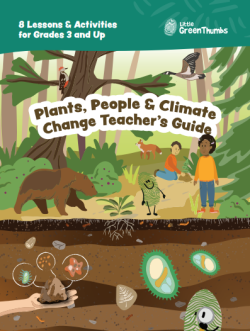
Plants, People and Climate Change
A journey of climate change education through the world of plants
Elementary, Middle
Description
This collection of easy-to-use activities, animated videos, and student worksheets explores climate change science through the tangible lens of plants, soil, gardens, and natural habitats, while encouraging personal reflection and storytelling. The eight lessons engage students in exploring the connections between plants, soil, ecosystems, and climate change while encouraging reflection on environmental issues. The resource also includes background information on climate change and guidance for respectfully weaving Indigenous knowledge and perspectives throughout the lesson plans.
Lessons 1-3 provide foundational knowledge about the important roles that plants fulfill on our environment and habitats, what plants need to be healthy and how plants survive in different environments
Lessons 4-5 introduce students to climate change through plants. Students learn about greenhouse gases, the greenhouse effect, weather versus climate, and photosynthesis before exploring how climate change affects plant health, adaptation, and the habitats that plants support
Lessons 6-7 focus on practical solutions to climate change by exploring the role of healthy soil as a carbon sink and the importance of microorganisms. Students also examine food systems and food waste, learning how everyday actions can help reduce emissions and conserve resources
Lesson 8 – In the final lesson, students build on their understanding of the connections between plants, people, and climate change by exploring additional climate solutions. They then apply their learning through a personal climate action project that makes a positive impact in their community.
The resource is accessible to a wide range of learning environments, as lessons can be effectively implemented without access to a garden. While a garden can enhance the hands-on learning experience, each lesson includes activities that can be completed indoors or in settings without an outdoor growing space Teachers can apply for an indoor growing kit and learning resources on the Little Green Thumbs website.
The resource is accompanied by a supplementary guide - My Climate Story - that helps students reflect on the personal meaning of what they learn, while considering their own lives, what matters to them and their health.
General Assessment
Strengths
- the entire set of videos, activities, and student hand-outs is available free to download
- activities and lesson plans are easy to use, and provide all necessary materials
- provides a hands-on, experientiel approach to climate change education
- lessons are interdisciplinary allowing teacher sto integrate climate change across the curriculum
- provides background information and easy steps to follow to navigate the resource
- offers flexibility, teachers can go step by step through the lesson plans in order or take elements and activities of each lesson plan
- provides suggestions to incorporate Indigenous Ways of Knowing
Weaknesses
- some activities may be more challenging for schools with limited access to growing spaces, materials, or time needed to maintain garden-based experiences
- teachers may want to develop additional assessment tools or rubrics to more formally evaluate student learning and climate action projects.
Relevant Curriculum Units
The following tool will allow you to explore the relevant curriculum matches for this resource. To start, select a province listed below.
- Step 1Select a province
- Alberta
- British Columbia
- Step 2Select a grade level
- Grade 3
- Grade 4
- Grade 5
- Step 3Select a subject
- Arts
- Step 4Relevant matches
- Arts Education: Works of art influence and are influenced by the world around us.
- Grade 6
- Step 3Select a subject
- Arts
- Step 4Relevant matches
- Arts Education: Experiencing art is a means to develop empathy for others’ perspectives and experiences
- Manitoba
- Step 2Select a grade level
- Grade 3
- Step 3Select a subject
- Arts
- Step 4Relevant matches
- Visual Arts
- Grade 4
- Step 3Select a subject
- Arts
- Step 4Relevant matches
- Visual Arts
- Grade 5
- Step 3Select a subject
- Arts
- Step 4Relevant matches
- Arts: Visual Art
- Grade 6
- Step 3Select a subject
- Arts
- Step 4Relevant matches
- Arts: Visual Art
- New Brunswick
- Step 2Select a grade level
- Grade 3
- Step 3Select a subject
- Science
- Step 4Relevant matches
- Our Local Environment : Scientific Literacy
- Visual Art
- Step 4Relevant matches
- Communicate
- Grade 4
- Step 3Select a subject
- Arts
- Step 4Relevant matches
- Arts General: Perceiving & Responding
- Visual Art
- Step 4Relevant matches
- Connect
- Grade 5
- Step 3Select a subject
- Arts
- Step 4Relevant matches
- Arts General: Perceiving & Responding
- Visual Art
- Step 4Relevant matches
- Connect
- Grade 6
- Step 3Select a subject
- Visual Art
- Step 4Relevant matches
- Connect
- Newfoundland & Labrador
- Northwest Territories
- Step 2Select a grade level
- Grade 3
- Grade 4
- Grade 5
- Step 3Select a subject
- Arts
- Step 4Relevant matches
- Arts Education: Works of art influence and are influenced by the world around us.
- Grade 6
- Step 3Select a subject
- Arts
- Step 4Relevant matches
- Arts Education: Experiencing art is a means to develop empathy for others’ perspectives and experiences
- Nova Scotia
- Step 2Select a grade level
- Grade 3
- Step 3Select a subject
- Science
- Step 4Relevant matches
- Science 3: Plants
- Visual Art
- Step 4Relevant matches
- Visual Arts 3: Investigate
- Grade 4
- Step 3Select a subject
- Science
- Step 4Relevant matches
- Science 4: Habitats
- Visual Art
- Step 4Relevant matches
- Visual Arts 4: Analyse
- Grade 5
- Step 3Select a subject
- Visual Art
- Step 4Relevant matches
- Visual Arts 5: Analyse
- Grade 6
- Step 3Select a subject
- Science
- Step 4Relevant matches
- Science 6: Diversity of Life
- Visual Art
- Step 4Relevant matches
- Visual Arts 6 Analyse
- Nunavut
- Ontario
- Step 2Select a grade level
- Grade 3
- Step 3Select a subject
- Arts
- Step 4Relevant matches
- Arts: Visual Arts
- Science & Technology
- Step 4Relevant matches
- Life Systems: Growth & Changes in Plants
- Grade 4
- Step 3Select a subject
- Arts
- Step 4Relevant matches
- Arts: Visual Arts
- Science & Technology
- Step 4Relevant matches
- Life Systems: Habitats and Communities
- Grade 5
- Step 3Select a subject
- Arts
- Step 4Relevant matches
- Arts: Visual Arts
- Grade 6
- Step 3Select a subject
- Arts
- Step 4Relevant matches
- Arts: Visual Arts
- Science & Technology
- Step 4Relevant matches
- Life Systems: Biodiversity
- Prince Edward Island
- Step 2Select a grade level
- Grade 3
- Grade 4
- Step 3Select a subject
- Visual Art
- Step 4Relevant matches
- Visual Arts: Exploring Forms and Cultural Context
- Grade 5
- Step 3Select a subject
- Visual Art
- Step 4Relevant matches
- Vsual Arts: Refl ecting, Responding, and Analysing
- Grade 6
- Step 3Select a subject
- Science
- Step 4Relevant matches
- Diversity of Life
- Visual Art
- Step 4Relevant matches
- Visual Art: Exploring Forms and Cultural Contexts
- Quebec
- Step 2Select a grade level
- Grade 3
- Step 3Select a subject
- Arts
- Step 4Relevant matches
- Arts: Visual Arts: To appreciate works of art, traditional artistic objects, media images, personal productions and thos of classmates
- Science & Technology
- Step 4Relevant matches
- Living Things
- Grade 4
- Step 3Select a subject
- Arts
- Step 4Relevant matches
- Arts: Visual Arts: To appreciate works of art, traditional artistic objects, media images, personal productions and thos of classmates
- Science & Technology
- Step 4Relevant matches
- Living Things
- Grade 5
- Step 3Select a subject
- Arts
- Step 4Relevant matches
- Arts: Visual Arts: To appreciate works of art, media images, personal productions and those of classmates
- Science & Technology
- Step 4Relevant matches
- Living Things
- Grade 6
- Step 3Select a subject
- Arts
- Step 4Relevant matches
- Arts: Visual Arts: To appreciate works of art, media images, personal productions and those of classmates
- Science & Technology
- Step 4Relevant matches
- Living Things
- Saskatchewan
- Yukon Territory
- Step 2Select a grade level
- Grade 3
- Grade 4
- Grade 5
- Step 3Select a subject
- Arts
- Step 4Relevant matches
- Arts Education: Works of art influence and are influenced by the world around us.
- Grade 6
- Step 3Select a subject
- Arts
- Step 4Relevant matches
- Arts Education: Experiencing art is a means to develop empathy for others’ perspectives and experiences
Themes Addressed
Air, Atmosphere & Climate (1)
- Climate Change
Ecosystems (2)
- Appreciating the Natural World
- Biodiversity
Indigenous Knowledge (1)
- TEK -- Traditional Ecological Knowledge
Sustainability Education Principles
| Principle | Rating | Explanation |
|---|---|---|
| Consideration of Alternative Perspectives | Good | The resource considers alternative perspectives by incorporating Indigenous ways of knowing alongside Western scientific understandings of climate change, highlighting diverse relationships with plants, land, and the natural world. It encourages students to explore local knowledge and personal connections to nature. |
Consideration of Alternative Perspectives:
| ||
| Multiple Dimensions of Problems & Solutions | Good | The resource invites teachers to think of building a sustainable world through a systems thinking perspective and provides a diagram of three nesting rings of sustainability. The outer ring (Environmental Preservation) is a healthy environment that supports our livelihoods and provides services such as oxygen, pollination, and healthy ecosystems we rely on. The middle ring (Social Equity) is our society, which |
| Multiple Dimensions of Problems & Solutions: Effectively addresses the environmental, economic and social dimensions of the issue(s) being explored.
| ||
| Respects Complexity | Very Good | The lessons offer an exploration of |
| Respects Complexity: The complexity of the problems/issues being discussed is respected. | ||
| Acting on Learning | Good | In the final lesson, students will take up a larger action project they can do to take a personal climate action in their community. Students decide on a timeline and what roles each student will take for your chosen action project. They consider how to get every student involved and how they can celebrate its completion and inform others in their school community on the actions they are taking together. |
| Acting on Learning: Learning moves from understanding issues to working towards positive change — in personal lifestyle, in school, in the community, or for the planet
| ||
| Values Education | Very Good | Throughout the lessons, students have multiple opportunities to reflect on and express their own beliefs and values through personal reflection, discussion, storytelling, and action planning. The resource encourages students to consider their relationship with the natural world and how their individual choices can contribute to climate action. |
| Values Education: Students are explicitly provided with opportunities to identify, clarify and express their own beliefs/values. | ||
| Empathy & Respect for Humans | Poor/Not considered | Not considered in this resource |
| Empathy & Respect for Humans: Empathy and respect are fostered for diverse groups of humans (including different genders, ethnic groups, sexual preferences, etc.). | ||
| Personal Affinity with Earth | Very Good | The lesson moves beyond simply teaching about plants and climate change and helps students develop a personal relationship with the natural world through direct experiences, reflection, and action. Students develop a personal connection through hands-on exploration of plants, soil, gardens, and ecosystems. The resource encourages curiosity, appreciation, and stewardship by helping students recognize their relationship with nature and identify meaningful actions they can take to care for the environment. |
| Personal Affinity with Earth: Encourages a personal affinity with -the natural world.
| ||
| Locally-Focused Learning | Very Good | In the final lesson, students will implement an action project they can do to take a personal climate action in their community. |
| Locally-Focused Learning: Includes learning experiences that take advantage of issues/elements within the local community.
| ||
| Past, Present & Future | Satisfactory | One goal of the resource is to provide teachers with the confidence, inspiration, and knowledge needed to deliver effective climate change education and help foster a climate-literate generation. |
| Past, Present & Future: Promotes an understanding of the past, a sense of the present, and a positive vision for the future. | ||
Pedagogical Approaches
| Principle | Rating | Explanation |
|---|---|---|
| Open-Ended Instruction | Very Good | The lessons are structured to encourage inquiry, reflection and discussion, allowing for multiple perspectives and responses. This is supported by the resource's use of open-ended discussions, personal reflection and storytelling, exploration of Western and Indigenous perspectives and students-led climate action projects. |
| Open-Ended Instruction
: Lessons are structured so that multiple/complex answers are possible; students are not steered toward one 'right' answer. | ||
| Integrated Learning | Very Good | The resource uses a multi-disciplinary approach though its recommended activities, integrating learning across multiple subject areas, including geography, art, drama, math, health, science |
| Integrated Learning: Learning brings together content and skills from more than one subject area
| ||
| Inquiry Learning | Very Good | The activities effectively supports inquiry-based learning by encouraging students to ask questions, investigate environmental issues, reflect on their learning, and apply their understanding through meaningful climate action. |
| Inquiry Learning: Learning is directed by questions, problems, or challenges that students work to address.
| ||
| Differentiated Instruction | Good | The resource includes a variety of instructional approaches such as videos, discussion questions, interactive activities or exercises. Every lesson provides accommodation suggestions and extension activities. |
| Differentiated Instruction: Activities address a range of student learning styles, abilities and readiness.
| ||
| Experiential Learning | Very Good | The lesson plans support experiential learning by providing hands-on investigations, outdoor observations, reflection and opportunities for students to apply their learning through meaningful climate action. Students actively engage with plants and participate in authentic learning experiences rather than learn about climate change through text. |
| Experiential Learning: Authentic learning experiences are provided
| ||
| Cooperative Learning | Satisfactory | Some activities encourage students to work collaboratively in pairs or small groups. |
| Cooperative Learning: Group and cooperative learning strategies are a priority.
| ||
| Assessment & Evaluation | Good | Each lesson plan provides learning objectives and assessment suggestions that support both summative and formative evaluation. These include class discussions, student reflections, observations, inquiry activities, group work and student created climate action projects that allow students to demonstrate and apply their learning. |
| Assessment & Evaluation: Tools are provided that help students and teachers to capture formative and summative information about students' learning and performance. These tools may include reflection questions, checklists, rubrics, etc. | ||
| Peer Teaching | Good | The resource provides opportunities for students o actively communicate their learning through class discussions, collaborative activities, storytelling and pressentations of their climate action projects. |
| Peer Teaching: Provides opportunities for students to actively present their knowledge and skills to peers and/or act as teachers and mentors.
| ||
| Case Studies | Good | The resource does not include formal case studies. However, it presents information and stats about climate change from a variety of credible Canadian organizations. |
| Case Studies: Relevant case studies are included. Case studies are thorough descriptions of real events from real situations that students use to explore concepts in an authentic context. | ||
| Locus of Control | Very Good | Each lesson plan includes extension activities and a Dive Deeper section that provide opportunities to extend student learning and explore topics in greater depth. |
| Locus of Control: Meaningful opportunities are provided for students to choose elements of program content, the medium in which they wish to work, and/or to go deeper into a chosen issue. | ||