- Home
- Tutorial
- Resource Guides
- Focus Areas
- LSF Programs
-
Professional
Development - Review Process
-
A project of LSF

Search for Resources
Description
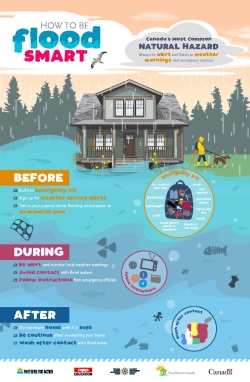
This lesson plan introduces students to the causes and impacts of flooding in Canada while exploring why flood preparedness is important for individuals and communities. Students will use the Flood Smart Canada infographic to learn about the many ways that their communities may be susceptible to floods and what they can do before, during and after a flood. They complete an exercise that involves conceptualizing, researching and creating their own accompanying infographic on a topic related to flooding.
Students will
- learn about the causes of floods in Canada, and how to prepare for and react to a flood in their community
- discuss floods in Canada and their own experiences with flooding or their perception of flooding gained from the media/books/movies.
- analyze an infographic and summarize the main message and most pertinent information
- become familiar with the steps involved in the creation of visualizations such as infographics.
- improve their critical thinking, research, and presentation skills
- share their infographics with the class
The resource includes an infographic that explains the causes of flooding in Canada and helps students understand how to prepare for flood events. It also features a tiled map of Canada highlighting regions that have experienced flooding in the past, as well as areas that may be at risk of future flooding.
Link to download the flood map
General Assessment
Strengths
- Particularly relevant as flooding becomes more frequent and severe across Canada
- Bilingual resource that connects learning to student's own experiences and communities
- Offers suggestions to extend the learning
Weaknesses
- No rubrics or detailed assessment criteria are provided
- The resource does not include experiential learning opportunities that takes place outdoors
- Some of the links to suggested resources are broken
- The resource could provide more differentiated strategies and supports for students who require additional assistance
Relevant Curriculum Units
The following tool will allow you to explore the relevant curriculum matches for this resource. To start, select a province listed below.
- Step 1Select a province
- Alberta
- Step 2Select a grade level
- Grade 9
- Step 3Select a subject
- Environmental Science
- Step 4Relevant matches
- Environment and Outdoor Education: Environmental Investigations
- Grade 10
- Step 3Select a subject
- Information Technology
- Step 4Relevant matches
- ICT Curriculum: Processes for Productivity
- Grade 11
- Step 3Select a subject
- Information Technology
- Step 4Relevant matches
- ICT Curriculum: Processes for Productivity
- Grade 12
- Step 3Select a subject
- Information Technology
- Step 4Relevant matches
- ICT Curriculum: Information & Communication Technology:Processes for Productivity
- British Columbia
- Step 2Select a grade level
- Grade 11
- Step 3Select a subject
- Science
- Step 4Relevant matches
- Earth Science 11: The transfer of energy through the atmosphere creates weather and is affected by climate change
- Science for Citizenship 11: Scientific understanding enables humans to respond and adapt to changes locally and globally
- Grade 12
- Step 3Select a subject
- Science
- Step 4Relevant matches
- Specialized Science 12: Climate change impacts biodiversity and ecosystem health
- Manitoba
- New Brunswick
- Step 2Select a grade level
- Grade 9
- Step 3Select a subject
- Social Studies
- Step 4Relevant matches
- Canadian Identities: Geography
- Newfoundland & Labrador
- Step 2Select a grade level
- Grade 9
- Step 3Select a subject
- Social Studies
- Step 4Relevant matches
- Geographic Influences on Identity: Place and Peopel
- Canadian Identity
- Grade 10
- Grade 11
- Step 3Select a subject
- Science
- Step 4Relevant matches
- Science 2200: Weather Dynamics
- Grade 12
- Step 3Select a subject
- Environmental Science
- Step 4Relevant matches
- Environmental Science 3205: Water Use & the Environment
- Northwest Territories
- Step 2Select a grade level
- Grade 11
- Step 3Select a subject
- Science
- Step 4Relevant matches
- Earth Science 11: The transfer of energy through the atmosphere creates weather and is affected by climate change
- Science for Citizenship 11: Scientific understanding enables humans to respond and adapt to changes locally and globally
- Grade 12
- Step 3Select a subject
- Science
- Step 4Relevant matches
- Specialized Science 12: Climate change impacts biodiversity and ecosystem health
- Nova Scotia
- Step 2Select a grade level
- Grade 9
- Step 3Select a subject
- Social Studies
- Step 4Relevant matches
- Citizenship 9: Global Citizenship
- Grade 10
- Grade 12
- Step 3Select a subject
- Geography
- Step 4Relevant matches
- Global Geography: Planet Earth
- Nunavut
- Ontario
- Step 2Select a grade level
- Grade 9
- Step 3Select a subject
- Geography
- Step 4Relevant matches
- Exploring Canadian Geography: Liveable Communities
- Grade 10
- Step 3Select a subject
- Science
- Step 4Relevant matches
- Science (Academic):Earth and Space Science: Climate Change
- Science (Applied)::Earth and Space Science: Earth's Dynamic Climate
- Grade 12
- Step 3Select a subject
- Geography
- Step 4Relevant matches
- The Environment & Resource Management (Univ/College Prep.) Community Action
- Prince Edward Island
- Step 2Select a grade level
- Grade 9
- Step 3Select a subject
- Information Technology
- Step 4Relevant matches
- Communication and Information Technology: Graphics
- Grade 12
- Step 3Select a subject
- Environmental Science
- Step 4Relevant matches
- Environmental Science 621A: Environmental Challenges and Successes
- Geography
- Step 4Relevant matches
- Geography 621A Global Issues: Introduction- What is a global issue?
- Geography 631A Global Issues: What are the issues?
- Information Technology
- Step 4Relevant matches
- Computer 801: Visual Presentations
- Saskatchewan
- Step 2Select a grade level
- Grade 10
- Grade 11
- Step 3Select a subject
- Environmental Science
- Step 4Relevant matches
- Environmental Science 20: Aquatic Systems
- Yukon Territory
- Step 2Select a grade level
- Grade 11
- Step 3Select a subject
- Science
- Step 4Relevant matches
- Earth Science 11: The transfer of energy through the atmosphere creates weather and is affected by climate change
- Science for Citizenship 11: Scientific understanding enables humans to respond and adapt to changes locally and globally
- Grade 12
- Step 3Select a subject
- Science
- Step 4Relevant matches
- Specialized Science 12: Climate change impacts biodiversity and ecosystem health
Themes Addressed
Air, Atmosphere & Climate (2)
- Climate Change
- Weather
Water (1)
- Watershed Protection
Sustainability Education Principles
| Principle | Rating | Explanation |
|---|---|---|
| Consideration of Alternative Perspectives | Good | The resource provides some opportunities for students to consider different perspectives by discussing their personal experiences and perceptions of flooding, including those shaped by media, books, and movies. Students also evaluate the information presented in an infographic and consider what works well and what they might do differently. The resource does not explore or compare the perspectives of different groups or stakeholders affected by flooding. |
Consideration of Alternative Perspectives:
| ||
| Multiple Dimensions of Problems & Solutions | Good | The resource addresses the environmental and social dimensions of flooding. It explores the environmental causes and impacts of floods, the effects on individuals and communities, and the importance of preparedness. |
| Multiple Dimensions of Problems & Solutions: Effectively addresses the environmental, economic and social dimensions of the issue(s) being explored.
| ||
| Respects Complexity | Satisfactory | Students discuss the natural disasters they think occur most frequently in Canada and where they occur. The resource recognizes that flooding is a complex issue with multiple causes and impacts, and it encourages students to consider flood risks and preparedness. |
| Respects Complexity: The complexity of the problems/issues being discussed is respected. | ||
| Acting on Learning | Good | Students will learn how to design an infographic, choose a flooding-related topic, and create their own infographic. They will present their work to the class and explain their choices and design process. Infographics can also be printed and displayed around the school to share their learning. |
| Acting on Learning: Learning moves from understanding issues to working towards positive change — in personal lifestyle, in school, in the community, or for the planet
| ||
| Values Education | Good | Students share what they know about natural disasters in general (e.g., types, causes, impacts, frequency, location). They discuss the natural disasters they think occur most frequently in Canada and where they occur. Students who have previously experienced a natural disaster share what happened, how it affected them, how they and their family reacted, and what took place after the event was over. |
| Values Education: Students are explicitly provided with opportunities to identify, clarify and express their own beliefs/values. | ||
| Empathy & Respect for Humans | Poor/Not considered | Not considered in this resource |
| Empathy & Respect for Humans: Empathy and respect are fostered for diverse groups of humans (including different genders, ethnic groups, sexual preferences, etc.). | ||
| Personal Affinity with Earth | Good | The resource encourages students to become better prepared for floods while also learning about the geography of flooding and its widespread impacts across Canada. A tiled map of Canada shows different areas of the country that have experienced flooding in the past and those that may be affected in the future. |
| Personal Affinity with Earth: Encourages a personal affinity with -the natural world.
| ||
| Locally-Focused Learning | Very Good | The learning is relevant to the lives of the students as flooding can affect their families and communities. Students explore areas of Canada that have experienced or may experience flooding and learn practical steps they can take to prepare for and respond to floods. The resource also encourages students to connect the topic to their own experiences and understanding of natural disasters. |
| Locally-Focused Learning: Includes learning experiences that take advantage of issues/elements within the local community.
| ||
| Past, Present & Future | Good | The resource provides a tiled map of Canada showing different areas of the country that have experienced flooding in past and those that may be affected in the future. |
| Past, Present & Future: Promotes an understanding of the past, a sense of the present, and a positive vision for the future. | ||
Pedagogical Approaches
| Principle | Rating | Explanation |
|---|---|---|
| Open-Ended Instruction | Very Good | Students will use the FloodSmart Canada infographic to learn about the many ways that their communities may be susceptible to floods and what they can do before, during and after a flood. They will conceptualize, research and create their own infographic on a topic related to flooding |
| Open-Ended Instruction
: Lessons are structured so that multiple/complex answers are possible; students are not steered toward one 'right' answer. | ||
| Integrated Learning | Good |
|
| Integrated Learning: Learning brings together content and skills from more than one subject area
| ||
| Inquiry Learning | Good | This resource uses a more guided inquiry approach, with teacher guidance and structured activities supporting students as they draw on their prior knowledge and conduct research to determine the message they wish to convey and gather the information needed to create their infographic. |
| Inquiry Learning: Learning is directed by questions, problems, or challenges that students work to address.
| ||
| Differentiated Instruction | Satisfactory | The lesson plan provides modifications for the infographic activity but does not provide specific modifications or accommodations for students with learning difficulties. |
| Differentiated Instruction: Activities address a range of student learning styles, abilities and readiness.
| ||
| Experiential Learning | Satisfactory | The resource incorporates some elements of experiential learning by connecting students to the real-world issue of flooding and having them apply their learning through research and the creation of an infographic. |
| Experiential Learning: Authentic learning experiences are provided
| ||
| Cooperative Learning | Satisfactory | Students share ideas and discuss their knowledge and experiences. |
| Cooperative Learning: Group and cooperative learning strategies are a priority.
| ||
| Assessment & Evaluation | Good | The lesson plan provides a few assessment suggestions, but no rubrics are provided. |
| Assessment & Evaluation: Tools are provided that help students and teachers to capture formative and summative information about students' learning and performance. These tools may include reflection questions, checklists, rubrics, etc. | ||
| Peer Teaching | Good | Students present their infographics to the class, explaining their decision-making and design process. Teachers may also display the infographics within the school to share students’ learning with a wider audience. |
| Peer Teaching: Provides opportunities for students to actively present their knowledge and skills to peers and/or act as teachers and mentors.
| ||
| Case Studies | Satisfactory | The resource provides a tiled map of Canada showing different areas of the country that have experienced flooding in past and those that may be affected in the future. |
| Case Studies: Relevant case studies are included. Case studies are thorough descriptions of real events from real situations that students use to explore concepts in an authentic context. | ||
| Locus of Control | Satisfactory | The resource provides activities to extend the learning such as designing a game to teach younger students in the school about flood safety. |
| Locus of Control: Meaningful opportunities are provided for students to choose elements of program content, the medium in which they wish to work, and/or to go deeper into a chosen issue. | ||