- Home
- Tutorial
- Resource Guides
- Focus Areas
- LSF Programs
-
Professional
Development - Review Process
-
A project of LSF

Search for Resources
Description
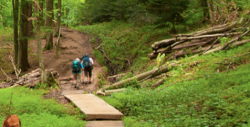
With these activities the students discover their own special wild spaces, where they can explore their relationship with the outdoors and develop an appreciation for the natural world.
In Activity #1, the students take a field trip to find their own special place. Once there they observe their surroundings and record their observations, thoughts and feelings on a chart.
In Activity #2, the students read and discuss a story with two conflicting perspectives on how to treat a special wild place. They will discuss the dilemma, brainstorm resolutions and create their own ending to the story.
In Activity #3, the students participate in a role-playing game in which they work as an animal to find the four necessities that are key to their habitat needs.
In Activity #4, the students complete web-based research and then a quiz that involves matching the descriptions of protected areas in Canada with the province/territory in which they are found.
In Activity #5, the students research an adventure trip to one of Canada's protected areas.
General Assessment
What skills does this resource explicitly teach?
This resource teaches the following skills:
- mapping
- problem-solving
- cooperation
- team building
- researching
- writing for a special purpose
Strengths
The strengths of the resource are:
- excellent resource sheets and background information are provided
- the activities are novel, interesting and worthwhile
- the evaluation sections provide good ideas
- respect for nature is encouraged
Weaknesses
The weaknesses of the resource are:
- supporting material for the Activity #3 is no longer accessible
- several links to the Wild Education site are no longer working
Relevant Curriculum Units
The following tool will allow you to explore the relevant curriculum matches for this resource. To start, select a province listed below.
- Step 1Select a province
- Alberta
- Manitoba
- Newfoundland & Labrador
- Nova Scotia
- Nunavut
- Step 2Select a grade level
- Grade 5
- Step 3Select a subject
- Grade 6
- Step 3Select a subject
- Grade 7
- Step 3Select a subject
- Indigenous Languages and Cultures
- Step 4Relevant matches
- Relationship to the Environment
- Science
- Step 4Relevant matches
- Interactions and Ecosystems
- Grade 8
- Step 3Select a subject
- Science
- Step 4Relevant matches
- Interactions in Our Environment
- Ontario
- Step 2Select a grade level
- Grade 6
- Step 3Select a subject
- Science & Technology
- Step 4Relevant matches
- Life Systems: Biodiversity
- Grade 7
- Step 3Select a subject
- Science & Technology
- Step 4Relevant matches
- Life Systems: Interactions in the Environment
- Prince Edward Island
- Quebec
- Step 2Select a grade level
- Grade 6
- Step 3Select a subject
- Science & Technology
- Step 4Relevant matches
- Living Things
- Grade 7
- Step 3Select a subject
- Science & Technology
- Step 4Relevant matches
- The Living World
- Grade 8
- Step 3Select a subject
- Science & Technology
- Step 4Relevant matches
- The Living World
- Saskatchewan
Themes Addressed
Citizenship (1)
- General Guide to Taking Action
Ecosystems (4)
- Appreciating the Natural World
- Habitat Loss
- Interdependence
- Wildlife Protection
Food & Agriculture (1)
- Pesticides
Land Use & Natural Resources (2)
- Habitat Restoration
- Recreation
Sustainability Education Principles
| Principle | Rating | Explanation |
|---|---|---|
| Consideration of Alternative Perspectives | Very Good | The activities help the students to see the issues from a variety of perspectives. |
Consideration of Alternative Perspectives:
| ||
| Multiple Dimensions of Problems & Solutions | Very Good | |
| Multiple Dimensions of Problems & Solutions: Effectively addresses the environmental, economic and social dimensions of the issue(s) being explored.
| ||
| Respects Complexity | Good | The interactions between the social, environmental and economic aspects are presented. The resource only briefly touches on the need for development as our population grows and the consequences. |
| Respects Complexity: The complexity of the problems/issues being discussed is respected. | ||
| Acting on Learning | Satisfactory | The extension activity provides a valuable opportunity for the students to work towards bettering their community. |
| Acting on Learning: Learning moves from understanding issues to working towards positive change — in personal lifestyle, in school, in the community, or for the planet
| ||
| Values Education | Very Good | In Activities #2 and #3 the students are given the opportunity to develop their own ideas with the questions given. |
| Values Education: Students are explicitly provided with opportunities to identify, clarify and express their own beliefs/values. | ||
| Empathy & Respect for Humans | Good | The students in Activity #2 are shown two different perspectives on what a person may find beautiful in nature. |
| Empathy & Respect for Humans: Empathy and respect are fostered for diverse groups of humans (including different genders, ethnic groups, sexual preferences, etc.). | ||
| Personal Affinity with Earth | Very Good | This is definitely a strength of this resource. |
| Personal Affinity with Earth: Encourages a personal affinity with -the natural world.
| ||
| Locally-Focused Learning | Very Good | Activity #1, the extension for Activity #4 and the culminating event provide students with an opportunity to work in their local community. |
| Locally-Focused Learning: Includes learning experiences that take advantage of issues/elements within the local community.
| ||
| Past, Present & Future | Good | A strong sense of the present along with a positive view of the future is inherent in the resource. |
| Past, Present & Future: Promotes an understanding of the past, a sense of the present, and a positive vision for the future. | ||
Pedagogical Approaches
| Principle | Rating | Explanation |
|---|---|---|
| Open-Ended Instruction | Very Good | The discussion questions and activities allow the students to come to their own conclusions. |
| Open-Ended Instruction
: Lessons are structured so that multiple/complex answers are possible; students are not steered toward one 'right' answer. | ||
| Integrated Learning | Good | |
| Integrated Learning: Learning brings together content and skills from more than one subject area
| ||
| Inquiry Learning | Good | |
| Inquiry Learning: Learning is directed by questions, problems, or challenges that students work to address.
| ||
| Differentiated Instruction | Very Good | |
| Differentiated Instruction: Activities address a range of student learning styles, abilities and readiness.
| ||
| Experiential Learning | Very Good | |
| Experiential Learning: Authentic learning experiences are provided
| ||
| Cooperative Learning | Satisfactory | |
| Cooperative Learning: Group and cooperative learning strategies are a priority.
| ||
| Assessment & Evaluation | Good | Although there are no "tools" given within the document, the resource does include a section on evaluation with each activity that indicates what the skills the students should be able to demonstrate. |
| Assessment & Evaluation: Tools are provided that help students and teachers to capture formative and summative information about students' learning and performance. These tools may include reflection questions, checklists, rubrics, etc. | ||
| Peer Teaching | Good | |
| Peer Teaching: Provides opportunities for students to actively present their knowledge and skills to peers and/or act as teachers and mentors.
| ||
| Case Studies | Very Good | In Activities #4 and #5 the students examines protected spaces from around Canada. |
| Case Studies: Relevant case studies are included. Case studies are thorough descriptions of real events from real situations that students use to explore concepts in an authentic context. | ||
| Locus of Control | Satisfactory | Activity #5 is the only activity that offers choice to the students. They can create an adventure to one of Canada's protected places based on their interests. |
| Locus of Control: Meaningful opportunities are provided for students to choose elements of program content, the medium in which they wish to work, and/or to go deeper into a chosen issue. | ||