- Home
- Tutorial
- Resource Guides
- Focus Areas
- LSF Programs
-
Professional
Development - Review Process
-
A project of LSF

Search for Resources
Description
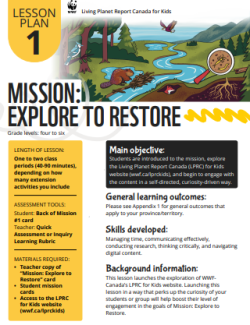
Mission: Explore to Restore is an eight-lesson inquiry-based learning unit that introduces students to wildlife, ecosystems, biodiversity, and conservation action. The unit is connected to the Living Planet Report Canada for Kids and is designed to help students understand how Canadian wildlife populations are changing and how people can help protect nature, species and habitats.
Students become “wildlife investigators” as they explore Canadian species, investigate ecosystem connections, learn how scientists collect wildlife data, and develop their own conservation actions. The lessons integrate science inquiry, outdoor learning, collaboration, and communication skills.
The eight lessons include:
Lesson 1 – Launch “Mission: Explore to Restore”
Students are introduced to the mission and explore the Living Planet Report Canada for Kids website. Students become wildlife investigators as they explore the site on their own
Lesson 2 – Scientists at Work
Students learn how wildlife scientists study animal populations, including how researchers collect and analyze information to understand changes in species numbers.
Lesson 3 – Wildlife Investigation
Students investigate a Canadian species and explore its habitat, adaptations, ecological role, and the challenges it faces.
Lesson 4 – All Species Are Connected
Through a tag game activity, students discover how plants, animals, and other organisms depend on each other and how changes to one species can affect an entire ecosystem.
Lesson 5 – Map the Connections
Students explore how scientists use maps to study habitats and species distribution. They create maps showing where wildlife lives and what habitats it needs.
Lesson 6 – Student Scientists at Work
Students collect and contribute their own observations and data through wildlife or ecosystem monitoring activities
Lesson 7 – “Explore to Restore” Pledge
Students identify realistic actions they can take to support wildlife conservation and commit to making a positive difference.
Lesson 8 – Think for Wildlife, Write for Change
Students reflect and share what they have learned by writing letters
Each lesson provides background information, Indigenous perspectives, assessment tools, materials required and extension activities to enhance the learning. The lessons include excerpts from the Living Planet Report Canada 2025 with expertise and experiences shared by contributors from Indigenous communities in different parts of the country. The resource includes four videos featuring WWF-Canada research scientist Jessica Currie discussing conservation and how students can take action to help conserve wildlife.
General Assessment
Strengths
- Students work with real-world wildlife data and conservation issues from WWF-Canada's Living Planet Report Canada
- Well-designed, inquiry based learning resource
- Resource is organized and easy to implement
- Provides a series of engaging and varied activities
- The resource empowers students to move beyond learning with practical actions
Weaknesses
- The resource offers varied learning activities but provides few explicit adaptations for English language learners, students with difficulties, or different reading levels.
Relevant Curriculum Units
The following tool will allow you to explore the relevant curriculum matches for this resource. To start, select a province listed below.
- Step 1Select a province
- Alberta
- British Columbia
- Manitoba
- Newfoundland & Labrador
- Northwest Territories
- Nova Scotia
- Step 2Select a grade level
- Grade 4
- Step 3Select a subject
- Information Technology
- Step 4Relevant matches
- Information and Communication Technology 4: Digital Citizenship
- Information and Communication Technology 4:Research, Innovation, Problem Solving, and Decision making
- Science
- Step 4Relevant matches
- Science 4: Habitats
- Grade 5
- Step 3Select a subject
- Information Technology
- Step 4Relevant matches
- Information and Communication Technology 5: Research, Problem Solving and Decision Making
- Grade 6
- Step 3Select a subject
- Information Technology
- Step 4Relevant matches
- Information and Communication Technology 6: Productivity and Innovation
- Science
- Step 4Relevant matches
- Science 6: Diversity of Life
- Nunavut
- Ontario
- Step 2Select a grade level
- Grade 4
- Step 3Select a subject
- Science & Technology
- Step 4Relevant matches
- Life Systems: Habitats and Communities
- Grade 6
- Step 3Select a subject
- Science & Technology
- Step 4Relevant matches
- Life Systems: Biodiversity
- Prince Edward Island
- Quebec
- Step 2Select a grade level
- Grade 4
- Step 3Select a subject
- Science & Technology
- Step 4Relevant matches
- Living Things
- Grade 5
- Step 3Select a subject
- Science & Technology
- Step 4Relevant matches
- Living Things
- Grade 6
- Step 3Select a subject
- Science & Technology
- Step 4Relevant matches
- Living Things
- Saskatchewan
- Yukon Territory
Themes Addressed
Ecosystems (6)
- Appreciating the Natural World
- Biodiversity
- Endangered Species
- Habitat Loss
- Interdependence
- Wildlife Protection
Indigenous Knowledge (1)
- TEK -- Traditional Ecological Knowledge
Land Use & Natural Resources (1)
- Habitat Restoration
Sustainability Education Principles
| Principle | Rating | Explanation |
|---|---|---|
| Consideration of Alternative Perspectives | Very Good | The resource is connected to the Living Planet Report Canada for Kids and is designed to help students understand how Canadian wildlife populations are changing and how people can help protect nature, species and habitats. These resources are informed by WWF-Canada’s Living Planet Report Canada 2025, the report summarizes how wildlife in our country are faring. This report is published every few years to provide updated information and recommendations to help guide politicians, business leaders and the public as they make decisions that impact wildlife and habitats. |
Consideration of Alternative Perspectives:
| ||
| Multiple Dimensions of Problems & Solutions | Good | The resource addresses the environmental dimensions of biodiversity and conservation by exploring wildlife, ecosystems, habitat needs, and species interactions. It supports the social dimensions of sustainability by encouraging students to become informed environmental stewards and take action to protect wildlife. |
| Multiple Dimensions of Problems & Solutions: Effectively addresses the environmental, economic and social dimensions of the issue(s) being explored.
| ||
| Respects Complexity | Very Good | The resource respects the complexity of biodiversity and conservation issues by showing that wildlife populations are influenced by multiple interconnected factors, including habitat conditions, ecosystem relationships, human impacts, and conservation efforts. |
| Respects Complexity: The complexity of the problems/issues being discussed is respected. | ||
| Acting on Learning | Good | Students identify realistic actions they can take to support wildlife conservation and commit to making a positive difference. They explore the “How you can help” section of the LPRC for Kids website and choose an action to support wildlife and ecosystems. Students create a class pledge for the action and promote it through the school, home and wider community. Students can act as |
| Acting on Learning: Learning moves from understanding issues to working towards positive change — in personal lifestyle, in school, in the community, or for the planet
| ||
| Values Education | Good | Through investigation, discussion, and action-planning activities, students are encouraged to identify what they value about nature and communicate their perspectives on how to protect wildlife. |
| Values Education: Students are explicitly provided with opportunities to identify, clarify and express their own beliefs/values. | ||
| Empathy & Respect for Humans | Poor/Not considered | Not considered in this resource |
| Empathy & Respect for Humans: Empathy and respect are fostered for diverse groups of humans (including different genders, ethnic groups, sexual preferences, etc.). | ||
| Personal Affinity with Earth | Very Good | Lesson six introduces students to wildlife |
| Personal Affinity with Earth: Encourages a personal affinity with -the natural world.
| ||
| Locally-Focused Learning | Very Good | The class will decide on a project that will help wildlife in their school yard and wider community. |
| Locally-Focused Learning: Includes learning experiences that take advantage of issues/elements within the local community.
| ||
| Past, Present & Future | Good | The resource supports an understanding of the past by examining changes in wildlife populations and ecosystems over time and using scientific information to understand how species and habitats have been affected. It builds a sense of the present by helping students investigate current challenges facing Canadian wildlife, including biodiversity loss, habitat pressures, and the importance of conservation. |
| Past, Present & Future: Promotes an understanding of the past, a sense of the present, and a positive vision for the future. | ||
Pedagogical Approaches
| Principle | Rating | Explanation |
|---|---|---|
| Open-Ended Instruction | Very Good | Brainstorming, questioning and discovery, as well as cooperative learning activities provide opportunities for open-ended discussion and learning. |
| Open-Ended Instruction
: Lessons are structured so that multiple/complex answers are possible; students are not steered toward one 'right' answer. | ||
| Integrated Learning | Good |
|
| Integrated Learning: Learning brings together content and skills from more than one subject area
| ||
| Inquiry Learning | Very Good | Students learn by asking questions, investigating evidence, making observations, analyzing information, and drawing conclusions, rather than simply receiving information from the teacher. Throughout the unit, students take on the role of wildlife investigators, using scientific inquiry to understand ecosystems and conservation. |
| Inquiry Learning: Learning is directed by questions, problems, or challenges that students work to address.
| ||
| Differentiated Instruction | Good | The resource provides varied learning activities, but teachers may need to adapt some materials to fully meet the needs of diverse learners. |
| Differentiated Instruction: Activities address a range of student learning styles, abilities and readiness.
| ||
| Experiential Learning | Very Good | Students step into the role of scientists |
| Experiential Learning: Authentic learning experiences are provided
| ||
| Cooperative Learning | Satisfactory | Students work in groups for many of the activities. |
| Cooperative Learning: Group and cooperative learning strategies are a priority.
| ||
| Assessment & Evaluation | Very Good | Assessment in the resource focuses on |
| Assessment & Evaluation: Tools are provided that help students and teachers to capture formative and summative information about students' learning and performance. These tools may include reflection questions, checklists, rubrics, etc. | ||
| Peer Teaching | Good | Students create a class pledge for the action |
| Peer Teaching: Provides opportunities for students to actively present their knowledge and skills to peers and/or act as teachers and mentors.
| ||
| Case Studies | Very Good | These resources are informed by WWF-Canada’s Living Planet Report Canada 2025, the report summarizes how wildlife in our country are faring. This report is published every few years to provide updated information and recommendations to help guide politicians, business leaders and the public as they make decisions that impact wildlife and habitats. |
| Case Studies: Relevant case studies are included. Case studies are thorough descriptions of real events from real situations that students use to explore concepts in an authentic context. | ||
| Locus of Control | Good | Each lesson provides extension activities to enhance the learning or go deeper into a chosen issue. |
| Locus of Control: Meaningful opportunities are provided for students to choose elements of program content, the medium in which they wish to work, and/or to go deeper into a chosen issue. | ||